Patrik
Wise words of the week
Civilization advances by extending the number of important operations which we can perform without thinking about them. — Alfred North Whitehead
Computers are useless. They can only give you answers. — Pablo Picasso
Journal
Summer is over and between vacations and various urgent personal tasks we had to pause the blog, so it’s time to start again. We didn’t stop working on FI Planner (there were 3 releases in the last 3 months), but we had to prioritize a bit.
We silently made progress. I completely automated the various administrative processes behind the tool so that we are now ready to scale up operations without drowning in additional manual work, while Marc focused on tweaking the pricing models.
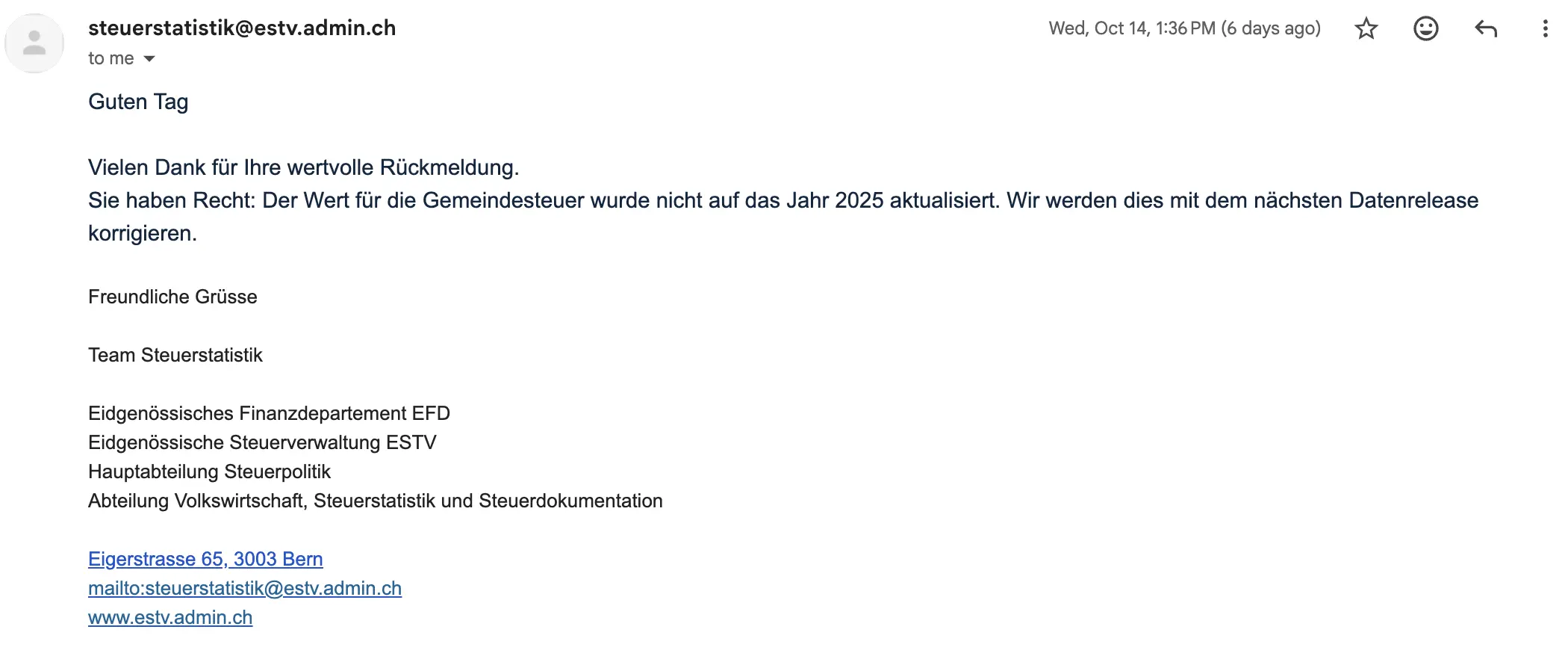
One nice “feel good” moment this summer was reporting a bug to the ESTV tax calculator: they missed updating one deduction to the 2025 value for married people in Wallis. Obviously I first spent many hours with lots of frustration about getting different results and assuming the reference calculator was correct and ours was wrong. That’s one nice side effect of having our own tax calculator.
Having our own tax computation was an expensive must-have. I quite underestimated the complexity of managing the federal tax and 26 cantonal systems. Currently we support 15 cantons but it gives us 87.8% coverage of the Swiss population. Luckily there’s a bit of standardization going on. The tax computation was key to building the tool: each simulation has to compute the taxes for each year during the simulation, and may have to compare multiple scenarios. In the most complex cases, a simulation may have to compute taxes a few dozen million times. Relying on an external 3rd party service would be expensive (they usually charge by the computation) and slow, defeating one of the key strengths of the product: fast computation allows using the tool interactively.
Now I can focus on bringing down the number of open issues and feature requests, currently around 120. Some are easy mechanical changes, like adding a note field next to each event or localizing all the error messages in the backend. Others may require some deeper thoughts, like actually returning the simulation results in the case of bankruptcy to help understand what went wrong or displaying the complete list of transactions done during the simulation.
I actually hope to be able to open our issue tracking system (using Linear, which I like a lot) to our users, to provide more transparency on the state of the tool.
Anyway, I’m enjoying this project a lot. The feedback is good, the progress is visible, I keep learning new things, and the alignment and collaboration with Marc is just great.
How did I use AI this week?
I’ve been relying much more on Cursor for doing the actual coding. In recent months, the models have significantly improved and they manage to understand what I want and get the information from the code base directly. I think this may also have to do with larger context sizes. But I was also touching parts of the code base that are less fun to me, the combination of subscription management and integration with external services.
This has helped greatly, but as usual the AI is much more defensive and tends to cover all corner cases, creating solid code that is much larger than what I would expect. So I spend a lot of time on reviewing and refactoring the results to understand and simplify them.
Another use of AI was driven by my own laziness. Tired of typing “my Junkers TFQ 2 thermostat…” and “my Delta Dore Calybox lost power and I need to reprogram it” I started taking pictures of the device and asking how I should set or change the configuration. And ta-dah, it just worked flawlessly.
I pushed the boundary to the extreme the other day, when I had to quickly pick a drink in a place with many fancy and unknown-to-me cocktails. I just took a picture of the menu and asked it to select a drink for me. As usual with AI, the selection was technically correct and it selected the signature drink of the place. But now I’m going to have to provide feedback to the AI that I’m actually more interested in a lemon taste than a ginger beer one. We live in interesting times.
Marc
The build
I spent the last couple of weeks working on our updated pricing model following all the feedback we received so far from people on the waiting list.
So far we had a subscription model only, with two plans.
But the more we talked to potential customers, the more we realized there was a split into two main groups:
- The first group of customers is the one similar to Patrik and me, who want a tool they can play with every month when they update their numbers (budget, checking their investments, etc.), to see how this impacts their FI projections
- The second group is more of a “one-shot” thing, where customers want to enter their numbers, confirm (or not) their assumptions, and maybe never come back. Or actually, maybe come back, but not every month.
Hence we decided to still offer two plans: a one-shot plan, and a subscription one.
Both include the entire feature set (compared to before, when the first plan had only a subset of it).
We are gradually rolling out this new pricing experiment this week, gathering lessons from it, and taking it from there.
It feels good, as after a calmer summer, things are moving again :)
The edge
As with any change in a product, it feels risky. Will customers hate you because of what you do? Or will they love you? And is it the best decision we could have made?
All these were thoughts running in my head for the past weeks. But now that we’ve settled, agreed and (still silently) launched the new pricing, I feel better because we took action.
It’s somehow crazy because even with our own long experience, Patrik and I, I still feel like it’s the first time we do such things, with all the doubts and impostor syndrome that go with it ahah.
So, yup, not the most reassuring period of big wins and co, but that’s part of the startup game, one experiment at a time.
Note to a friend
What would I tell a friend?… Hmmm, I guess it would be to trust your gut, all while relying on data. Even more so with pricing, which is half science, half art.
Indeed, don’t overthink it too much and take action, because that’s how you will gather more (real) data and stop working out every possible scenario.
As, unfortunately, no one can predict the future.
So, do your best work, and ship it. As fast as possible.
Tool of the week
If, like many of us at one point or another, you’re lost about what AI means for your job or the future of the world, but without the hype and co, I recommend you read the latest presentation by Benedict Evans: AI eats the world.