
Patrik
Wise words of the week
Civilization advances by extending the number of important operations which we can perform without thinking about them. — Alfred North Whitehead, An Introduction to Mathematics (1911)
The real question is not whether machines think but whether men do. — B. F. Skinner, Contingencies of Reinforcement (1969)
Journal
As I mentioned last week, I’m currently working on supporting new cantons. JU and GL are coded (as of 12 minutes ago). I could now spend 30 minutes ranting about the fragmentation of the Swiss tax system. But after 17 cantons out of 26, I’m feeling philosophical.
Convenient higher-level abstractions always win, once we can bear their cost.
What does that mean? Well, that we are mentally lazy (obviously) and are very happy and eager to adopt any change that makes a tool or technology easier for us to understand despite having a higher cost.
Usually, we start with some very simple and low-level abstraction that is very close to the underlying machine or hardware. Then someone brings up some new and better way that matches our way of thinking. Or, better, the “don’t make me think, just work” kind. It’s usually more expensive. The purists and experts will scream at the inefficiency, but eventually the technology becomes so powerful that it doesn’t matter anymore. Everyone adopts it and we move on and forget.
There are so many examples of this.
When programming languages emerged, people still coding in assembly language were upset that it let the developer waste so much memory instead of hand-crafting the memory layout themselves. Then more memory and faster machines kicked in.
When I joined Google in 2005, they were rolling out a new cluster management service called Borg that would manage and allocate machines automatically. It was replacing the Workqueue system, where I remember manually maintaining the list of machines dedicated to my service. And having to allocate and replace machines manually or issuing the “mdb reboot <machine-name>” (I forgot the exact syntax) to reboot a machine, knowing full well this would send a technician running through the datacenter to press a button on the machine. Obviously the people used to Workqueue complained heavily about the migration fittingly called “Borg Assimilation”, because the Borg resource tax was about 1-2% CPU usage, unheard of.
Another example was (is?) replacing all the manual cars with automatic ones. My biggest worry when we bought our first automatic car 15 years ago was “am I old now?”. Yet the technology was ripe and it was a pleasure to drive and I never looked back. Now carmakers are phasing out manual cars and electric cars don’t even have gears at all.
The same happens with the conversational interface using AI. Sure, I could code against an API and be a few orders of magnitude more efficient. But the convenience of using a conversational agent is unbeatable. So we see chatbots everywhere.
We can’t stop progress, we can only miss the train.
How did I use AI this week?
I do have a process for my releases, and it includes going to Linear and updating all the issues I worked on. First I create a new label for the release, second I apply the label to all the issues in Ready state, and third I change them to Done state. It’s easy to remember but since I do it only every 3-4 weeks, I keep forgetting the exact way to do it. Not to mention the keyboard shortcuts.
The first time, I asked Gemini how to do it and it gave me the exact instructions including the keyboard shortcuts.
The second time I noticed that Linear has an agent, so I entered the same instructions there and it just happened.
Is this more efficient? Well, narrowly looking at the computing resources involved, this would be total overkill. Why pull multiple systems together to do this when I could simply write down the keyboard shortcuts somewhere? But holistically (including my time), this is much more efficient, because I just say (write) what I want and it’s done.
The next step will be asking Cursor to just solve the issues in Linear one by one. Right now this won’t work, because those issues are just not detailed enough for Cursor to make sense of them. But with a bit of discipline, I’m sure I’ll start writing better issues that are more actionable.
The technology is doing a great job, the problem is between the keyboard and the chair.
Marc
The build
Go-To-Market (GTM)
I mostly spent time on go-to-market activities the past week.
As I talked about my FI journey on the MP blog, we noticed that many new people joined the FI Planner waitlist.
So we thought about running an experiment: let’s onboard one part of the waitlist that is the oldest (standard way), and another cohort that just joined. The goal being to see whether recency changes something in people’s interest. We’ll see later this week during my catch-up with Patrik.
Onboarding
In parallel to this activity, my next focus was (and still is) on the onboarding and “getting a grasp” of our FI calculator. Because we often get the feedback that our demo video on our homepage is nice, but people wanna play with the tool by themselves.
And I can’t blame them, as I’m the same. But it wasn’t our priority so far, as we first wanted to have a top-notch tool that computes everything correctly with your taxes and co, before thinking about the onboarding itself.
But as Patrik (and all his agent friends haha) develop new features as fast as one can, the time has come to shift our focus to our next pain point in the user journey (that’s you here! ;)). Namely, the onboarding process.
Interestingly enough, we may combine yet another pricing experiment within this new user flow. More on that below.
The edge
“Free things all the way!!!” :D
That may be our most common recurring theme with Patrik where we “disagree”. And I mean, disagree in a constructive way. Which is what I like about our cooperation, because we are two rational minds that are open to feedback. And most importantly to experimenting.
So, the thing is Patrik would go more down the freemium route (if I wasn’t a PITA on this topic), to see more and more users play with new ideas and features he has for FI Planner. I really like that too, as I see him as the crazy inventor with more ideas than I can manage to pack into our user interface haha.
But, on my end, while this idea is tempting me too, I know from successful startups that freemium is cool when you scale, but beforehand it’s just like the siren song that lures you into thinking that many free users will wanna pay for your solution once they’ve tried it… But in the end, you get more support requests from free users, and you develop it, but it barely gets used as they actually don’t see that much value in it.
And don’t get me wrong (because the above may seem arrogant): all I am saying here is from a Product perspective: if you provide true value, people (myself included) will be eager to pay you for using it. Which means that, in reverse, if no one is willing to pay you for a service you provide, it means that the added value isn’t there. And I don’t like not adding value to the world. And if I do, I want to be so good that you can’t just ignore it.
Note to a friend
Experiment. Always!
Why? Because until you put something live on the Internet (and get back concrete data points out of it), your fantastic-crazy-super-duper-idea is only random thoughts in one person’s head in the world, full of assumptions…
Tool of the week
Whenever I feel the need for a break, I now travel virtually and randomly to another place in the world, via audio.
How come?! Well, I found this very nicely done app called “Radio Garden”.
You open it, and tap on “Take a Balloon Ride”, and it lands you somewhere in the world. What I love the most is, first, to hear a voice in another language or with another German or French or English accent. But, second, I LOVE the fact that you don’t see where you landed, and you can wait a few seconds so the map scales back gradually (I love trying to guess as it reveals!)
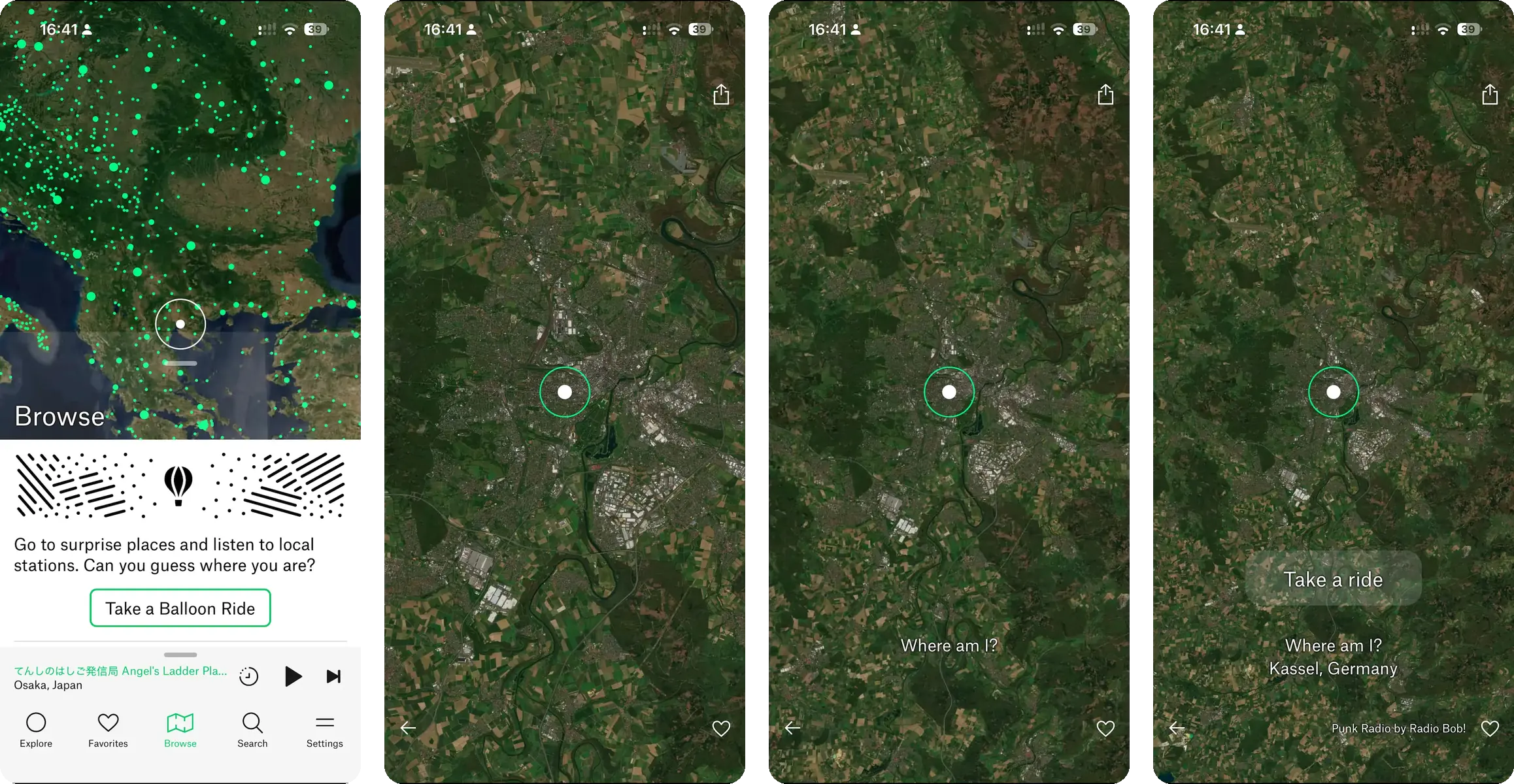
You can also browse the world as you would within Google Maps, and choose a radio station randomly from a place you wanna visit.
Just search for “Radio Garden” on your favorite app store ;)