
Patrik
Wise words of the week
Less is more.
Journal
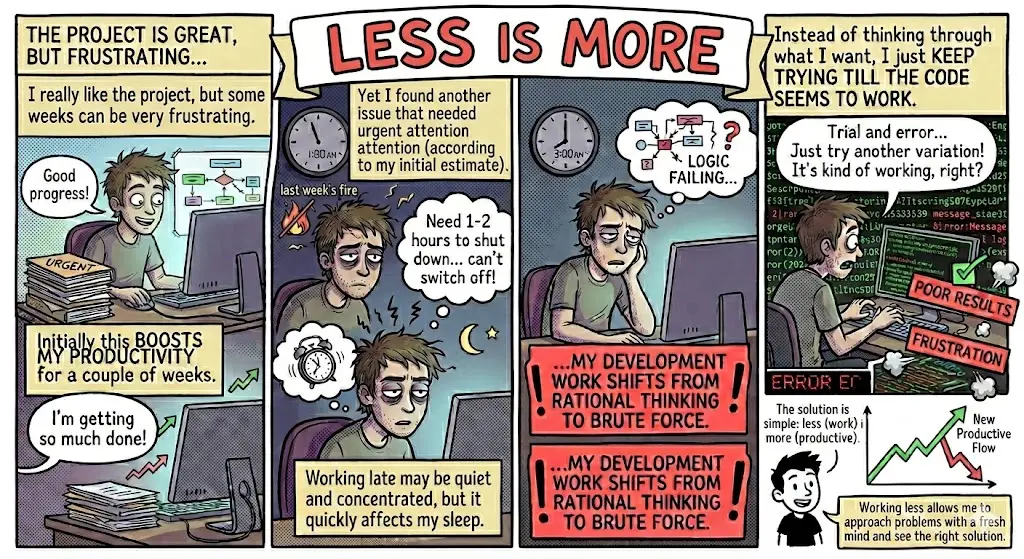
I really like the project but some weeks can be very frustrating. After putting out last week’s fire, I was looking forward to returning to the normal development flow. Yet I found another issue that needed urgent attention (according to my initial estimate). I implemented a significant part of the solution to assess its impact and realized it’s less urgent than I expected. However, since I was already halfway through, I decided to finish it to avoid context switching.
After 30+ years of development, I figured out that I’m most effective when coding in the morning, late afternoon, and evenings. I usually reserve the early afternoon for administrative tasks and try to avoid working after dinner.
Yet, when urgent matters arise, I start using the reserved time and working later in the evening. Initially this boosts my productivity for a couple of weeks. After that a very negative feedback cycle kicks in. Working late may be quiet and concentrated but it quickly affects my sleep because I need 1-2 hours to shut down. Time makes me tired. And when I’m tired something really bad happens: my development work shifts from rational thinking to brute force. Instead of thinking through what I want, I just keep trying till the code seems to work. But this usually yields very poor results.
The solution is simple: less (work) is more (productive). Working less allows me to approach problems with a fresh mind and see the right solution.
How did I use AI this week?
I had to fix a problem in the OASI computation. Since this was very old code and a new spec was released earlier this year, I tried an experiment: feeding the specification to Cursor. Not the full AHVG law, but just the technical document with the formulas.
Cursor worked on it for a little while and generated a complete implementation of those algorithms. I was quite surprised, because the document is just a PDF and the algorithms are expressed as flowcharts (graphics).
I had some minor (usual) issues regarding function naming: initially, they were named after the document section where they were defined, such as “Chapter 1.2.” I asked it to use something meaningful, but I ended up with those Java-style names that are sometimes longer than a line and include more details than the algorithm itself. Some refactoring will fix it. Eventually.
I then started writing the layer in pseudocode to connect my simulation with those functions. Basically a structure to store the state, a method to update the state when the pension is claimed, and one function to compute the actual amount. I then iterated with the AI to refine the implementation, turning the pseudocode into functional code, which actually worked really well.
Then I created a few tests using results from the official calculator (ESCAL). The first 3 tests worked, but the 4th failed. And I realized that in the initial step, Cursor had generated functions that didn’t match the specification document. So, first I lost a lot of trust in the process. Second, I will have to carefully validate them manually, or actually try some specific models like Claude or Codex to see if the results improve.
Marc
The build
This week was very productive, as I could finish the integration of all our documentation spread between emails and our former website section, and pour it all into our beautiful inline documentation system.
That feels like strong progress!
On another note, we’re getting several requests for a “Done-for-you” financial independence planning package. We spent some time with Patrik crafting the offering, and testing it with a real person. Those exchanges are grounded in reality, and we learnt a lot. We will publish this package on our website pricing page once it’s finalized. Stay tuned ;)
The edge
Emails. As much as I love to learn about FI Planner clients’ challenges (and help solve them), I hate having more emails.
On top of our new inline documentation that will greatly help to reduce the number of those emails, there are three other ideas I plan to explore:
- Using the Virtual Assistant (VA) of my blog to help with Customer Success tasks on FI Planner (but I prefer to fix the root cause beforehand)
- Adding a RAG chatbot within the web app, so that users can search within the entire documentation intuitively
- Reinventing the whole user flow as explained in our previous blogpost
Books and AI. Another thing I struggle with. I love NotebookLM as it’s a great way to study a source (PDF, videos, etc.) without being influenced by web info, which makes it a perfect candidate to upload a book’s PDF, and then exchange with it about the ideas in it. BUT, I struggle to do it often because… I don’t wanna feed Google (and other LLM providers) with free content of writers… If you have a take on this, I’m all ears!
Note to a friend
I need to remind myself about that every time I face a problem, when I try to invent the solution by myself but… most of our problems were often already faced by someone else. So to speed your way to a great solution, it’s often best to look for best practices around it. And more precisely books. Because if someone has taken the time to write a book about it, it means they should know a thing or two about it (vs. X or Reddit).
This week, in particular, I was stuck on our offering for the “Done-for-you” package. That’s when I reopened my preferred pricing and packaging book: Monetizing Innovation. A goldmine of info that unstuck me in seconds.
Tool of the week
Claude Design, for sure!
I just took our Design System info, as well as a few other screenshots. I simply asked Claude Design to make it better and more readable. One prompt, and this result:
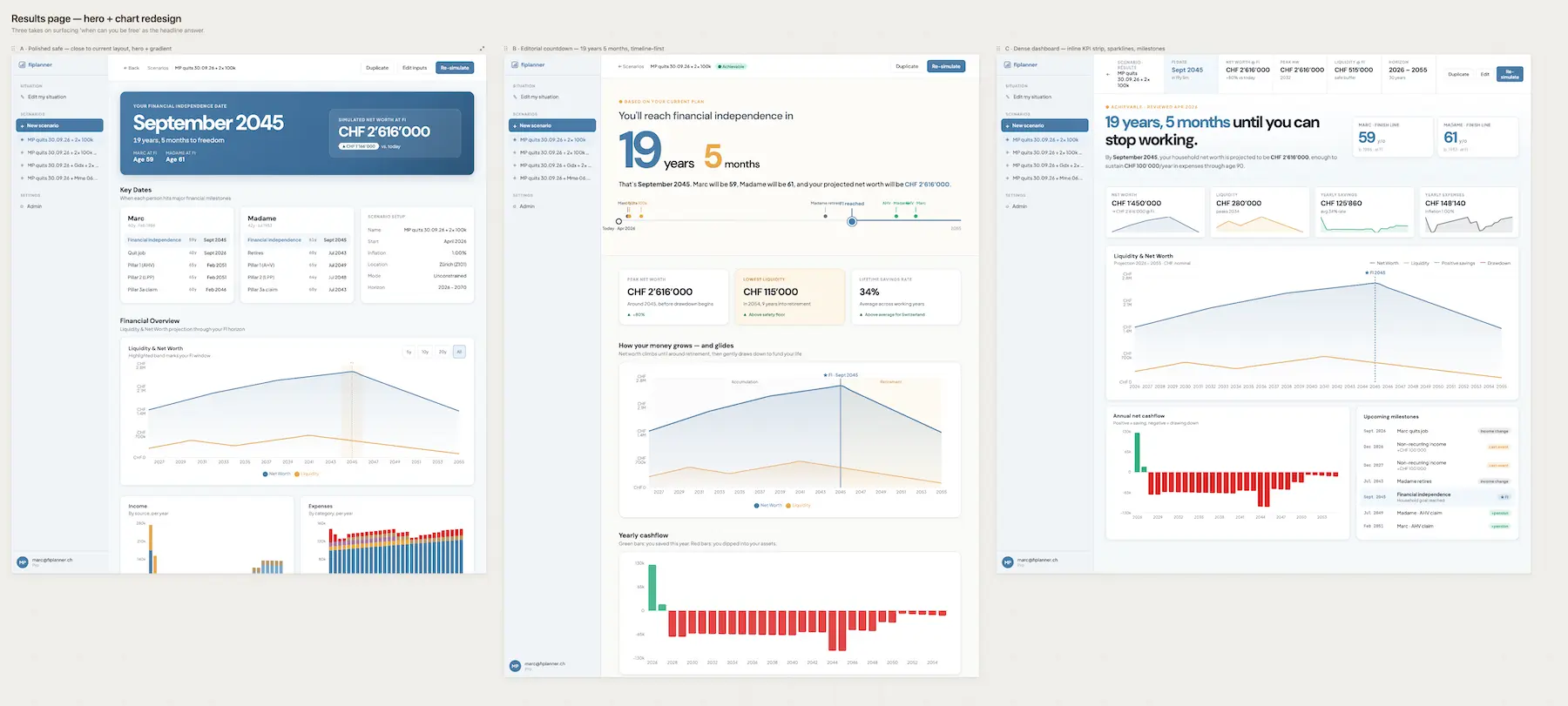
Mind blowing! I can’t wait for future tools to plug everything together, from the idea, to the development, testing, and deployment to production. I know products like Lovable exist, but I’m talking about more complex web applications.
Anyway, exciting times ahead! Try it and let me know about your own results, I’m curious.
Speaking of Claude: I also just discovered that Claude Max isn’t only available as the 200 USD/month plan (the same tier as ChatGPT Pro). There’s now a 100 USD/month tier too (ChatGPT has that too by the way). Given how my recent extra-usage charges have been piling up, I caved and subscribed for the month of May ;)